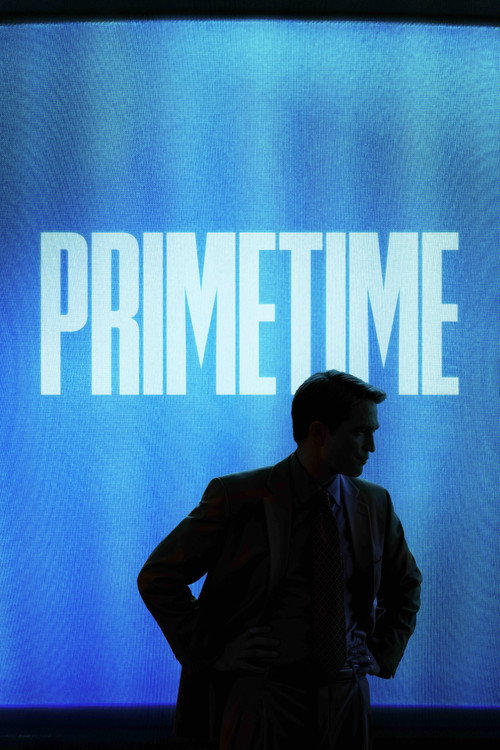
Primetime is a Surrealist Descent into the Cost of Televised Justice
Primetime walks the tightrope of a truly unsettling character study and eerie satire of the reality television machine. The film does stumble as it attempts to find a proper balance of its heavy-handed script and aesthetic goals. Regardless of the issues Primetime has in terms of execution, it makes many poignant and relevant observations about the line between moral crusades and egoistic self-gratification.
The Uncanny Performance at the Center
Robert Pattinson perfects the fast, measured delivery Hansen is known for, but this is just the vehicle for something deeper. His desperation to hold on to a career he has clearly outgrown and the collapse of his increasingly fragile sense of sanity gives the performance of Hansen a depth and richness that carries the film. His delivery isn’t the only thing that’s measured here, and because it’s about a man unraveling, it would have been easy to force the performance. Thankfully, that is not the case here, and because of this restraint, there is a naturalness to Pattinson’s performance.
Pattinson’s lead certainly draws the focus, and the supporting cast captures the friction caused by his abrasive nature. Merritt Wever gives a perfectly lived-in performance as Hansen’s producer and Skyler Gisondo offers a performance as Hansen’s producer’s son that resonates with rawness. The script paints Hansen as being unhinged early on, but these two ground the narrative and the performances within it.
Style Over Substance in the Fever Dream
Visually the film is brilliant. The use of color and expressionism convey the moral decay of the subject. The direction creates a hallucinogenic and surreal quality. This gives the mundane and familiar settings of the suburbs an alien and unsettling quality. The use of an artificial construct to convey the artificiality of reality television gives the film its visual strength.
The surreal quality and expressive imagery often conceal the ethical and moral questions the film raises. This leaves the audience with a series of profound images to ponder over and interpret in their own way. The images fail to provide a meaningful critique and engagement with the true crime genre.
Who Should Engage with This Moral Ambiguity
This film is for the audience that appreciates character-driven dramas that take precedence with mood and performance over plot. This film’s erratic pacing and stylistic flourishes may reward or frustrate viewers who are looking for a more conventional, linear investigative thriller. This movie is a difficult watch and audiences will be divided. Those viewers who appreciate a more conventional satire will find the movie baffling. The ambiguity is definitely off-putting. The film, however, plays with the boundary of conventionality and gives viewers plenty to muse over if they are fans of challenging genre experiments. Viewers will, however, find that this movie doesn’t really lend itself to passive observing. This movie is incredibly critical and raises an array of uncomfortable and undesirable questions about morality and ethics of journalism and the public’s obsession with celebrities. Viewers who can get past the negativity portrayed in the movie will find an incredibly gratifying performance and an exploration into the dark and sinister nature of the public’s obsession with celebrities.
Primetime: Ending Explained
(Spoilers ahead) The closing scenes of the film illustrate the final, brutal realization of the film’s core theme. The obsessive pursuit of “justice” through the lens of a camera ultimately devours the pursuer. As the operation becomes a nightmare, the line between the predator and the journalist fades away entirely. In the end, it seems that the camera became part of the predator. It is implied that, by selling his morality for a higher audience rating, and ultimately staking his humanity, he has become the predator and lost his humanity. The audience is left to make their own moral judgement about the ending, which is perhaps the most fitting ending to the story about the corrosive effects of fame.