Come Hell Or High Water: The Battle off Samar
Come Hell or High Water: The Battle off Samar
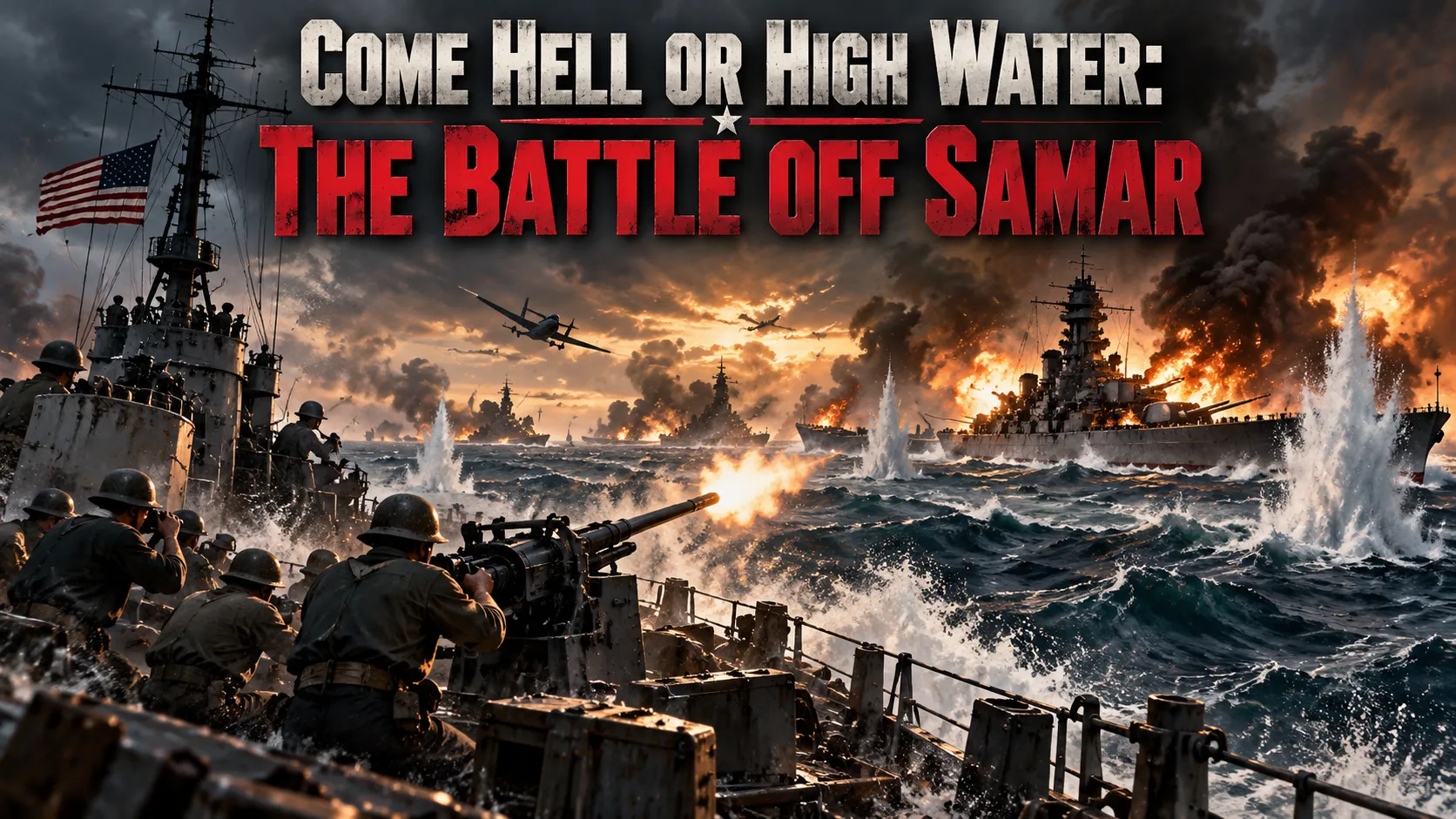
Come Hell or High Water is a historical war drama that takes inspiration from the actions of Commander Ernest Edwin Evans during the Battle off Samar in October 1944.
Evans’ leadership during this battle played a critical role in slowing the advance of the Japanese fleet, buying time for the Allies to mobilize their larger fleet to the area.
The film has been directed by John Moore and written by William Wisher, although the status of the film has not been officially confirmed.
The events that inspired the film create a strong foundation for depicting what it means to be a leader, especially when dealing with a moral responsibility in the face of overwhelming circumstances.
What Is Come Hell or High Water About?
The film is about Ernest Evans, commanding officer of USS Johnston, one of the American destroyers that fought during the Battle off Samar in October 1944.
On October 25, 1944, Evans and his crew assisted in a last-ditch defense against a larger Japanese fleet.
It was the American escort carrier group’s last line of defense in supporting the Allied landings in the Philippines.
It has been included in lists of most memorable instances in United States naval history of prolonged resistance against seemingly insurmountable odds.
Many historical accounts highlight Evans’ exceptional leadership and the vital role played by his ship in the battle.
However, detailed scenes of the script have not been released to the public.
Because of this, points, scenes, or dialogue should not be considered elements of the upcoming film project.
The Battle off Samar occurred during the larger Battle of Leyte Gulf, which is known to be one of the biggest naval battles of World War II.
American forces were assisting in the liberation of the Philippines when a strong Japanese formation appeared in their operational area.
The American unit threatened by the Japanese formation was Taffy 3, made up of six escort carriers, three destroyers and four destroyer escorts.
Taffy 3’s escort carriers and destroyers, along with supporting American aircraft, engaged in a defensive battle against the Japanese fleet, which included battleships and cruisers.
Because Taffy 3’s escort carriers and destroyers were outgunned and outmanned by the Japanese fleet, the crews made many sacrifices to help disrupt the Japanese formation.
The Japanese fleet commander decided to withdraw his forces and allow the American units to continue in their mission.
One of the lessons learned by naval forces is that despite being outmanned and outgunned, American naval units, with determination and vigorous action, can obstruct Japanese plans to defeat an American unit.
Ernie Evans, the commander of USS Johnston, distinguished himself during the defense of the escort carriers and helped obstruct the Japanese attacking force.
Evans was posthumously awarded the Medal of Honor for his actions during the battle.
The Naval History and Heritage Command maintains detailed records of his service, and is, therefore, in a position to provide the background to the events depicted in the film of interest to the general public.
John Moore and the Creative Team
Moore is known to have a directing interest in the project.
His directorial credits include “Behind Enemy Lines,” “Flight of the Phoenix,” and “A Good Day to Die Hard.” Moore has previous experience in directing large-scale dramatic and action films.
William Wisher, known for his screenplay for “Terminator 2: Judgment Day,” also has a creative interest in the project.
Production company, Maeday Productions, has been associated with the project.
In the case of developmental projects, credits should not be understood to mean principal photography has begun.
The approved final cast has not named an actor to portray Ernest Evans.
The final cast has not been determined and, as such, supporting roles and characters do not exist.
Production and Release
From an industry standpoint, this project remains in development and has not been completed.
An official release date has not been announced. There is no verified international distributor. The absence of a distribution deal may explain the lack of a theatrical release, trailer and/or production timeline.
Hypothetical searches do not confirm the film has a streaming release.
Likewise, searches related to the pikashow app download do not confirm availability.
Chronologically, the release of other films with similar titles predate the intended release of Come Hell Or High Water.
Until a distributor makes an official announcement, we will not know the date or location of the film’s release.
The Significance of The Battle off Samar
The importance of Samar does not end with the mismatch in the opposing fleets.
It illustrates the value of rapid, combinations of leadership and cooperation during extreme duress in one of the more difficult situations in the history of naval warfare.
It illustrates the contributions of many American sailors, marines, and airmen during the defense of the Philippine Islands.
This part of the war with Japan has yet to be told. It needs an in-depth research based screenplay that captures the courage and valor of the participants.
Although Come Hell Or High Water currently has no specific release dates, its subject matter is of great importance.
If made, it will have the opportunity to cover a significant chapter of naval history to a new audience.